
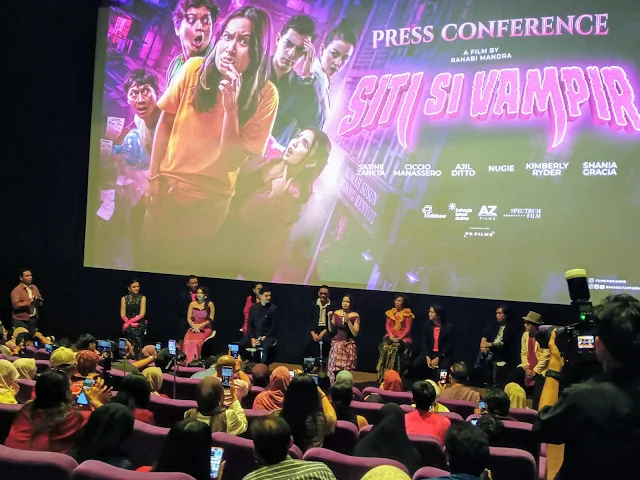

Breaking away from Indonesia’s familiar horror conventions, Siti Si Vampir introduces a fresh take on vampire mythology, combining supernatural comedy, anime-inspired visuals, and a sharp look at social inequality in Jakarta.
What happens when a vampire story meets the everyday struggles of ordinary Indonesians? The answer comes in Siti Si Vampir, an upcoming Indonesian horror-comedy that dares to venture beyond the country’s familiar world of kuntilanak, pocong, and other local supernatural figures.
Produced by Viddsee in collaboration with Bahagia Tanpa Drama, the film brings a globally recognized mythical creature into a distinctly Indonesian setting. Rather than relying solely on scares, Siti Si Vampir uses humor and fantasy to explore social realities, offering a fresh alternative to the horror films that have long dominated the local box office.
With Satine Zaneta taking the lead role as Siti and Rahabi Mandra directing, the film aims to deliver an unusual cinematic experience that is both entertaining and socially relevant.
A Vampire Story with an Indonesian Twist
In Indonesia, supernatural cinema has traditionally drawn heavily on local folklore, with familiar ghostly figures often taking center stage. Vampires, despite their popularity in international films and television, remain relatively rare in Indonesian cinema.
For producer Celerina Judisari, that absence presented an opportunity.
Speaking at the film’s press screening at XXI Epicentrum in Jakarta on Friday, October 16, Judisari explained that the team wanted to explore a different kind of supernatural story while finding new ways to reflect everyday social dynamics.
“Vampires are almost nonexistent in Indonesian films. Most horror movies feature kuntilanak or other local ghosts. So we saw an opportunity: what if we created a local vampire?” she said.
The combination of the familiar Indonesian name Siti and the supernatural figure of a vampire also creates an unexpected source of comedy.
By placing an extraordinary creature in an ordinary Indonesian context, the film aims to generate humor from cultural contrasts while delivering messages that resonate with contemporary audiences.
The result is a premise that feels both unusual and familiar: a vampire story that does not abandon its global mythology but reimagines it through an Indonesian lens.
Beyond the Supernatural: A Story About Social Inequality
Beneath its comedic premise, Siti Si Vampir also explores the divide between grassroots communities and social elites.
Director Rahabi Mandra sees this contrast as one of the film’s central challenges. Bringing vampire mythology into an Indonesian setting required more than simply adapting a supernatural character; it meant finding a way to connect fantasy with the social realities experienced by people in Jakarta.
Through Siti’s struggles, the film places a fantastical figure in the middle of a world shaped by class differences and everyday pressures.
This approach gives the horror-comedy a broader dimension. Instead of treating the vampire solely as a source of fear, the film uses the character as a vehicle for examining the tensions and contradictions of modern urban life.
Comedy becomes an important part of that storytelling strategy, allowing the filmmakers to address serious themes without losing the lighthearted spirit of the movie.
The juxtaposition between a mythical creature and recognizable social circumstances also opens the door to a different kind of supernatural satire — one in which the absurdity of real life can be just as striking as the fantasy on screen.
Anime-Inspired Visuals Bring a Fresh Cinematic Style
Another distinctive element of Siti Si Vampir is its visual approach.
Rather than following the conventional aesthetic of Indonesian horror, Rahabi Mandra incorporates anime-inspired visual elements into the film’s live-action storytelling.
The decision is intended to strengthen the film’s fantasy and comedy while giving audiences a viewing experience that feels different from more traditional genre productions.
“ We wanted to offer something fresh. The anime-inspired visual elements in Siti Si Vampir are intended to create a different viewing experience while reinforcing the comedy and fantasy we want to convey,” Rahabi explained.
This blend of live action and anime-inspired aesthetics suggests a willingness to experiment with how Indonesian genre films can look and feel.
It also complements the film’s unconventional premise. A story that combines vampires, Indonesian social realities, and comedy naturally lends itself to a more imaginative visual language than a conventional supernatural thriller.
For audiences accustomed to familiar horror imagery, the film’s stylistic choices could become one of its most distinctive features.
Satine Zaneta Takes on a Challenging New Role
At the heart of the story is Satine Zaneta, who plays the titular character, Siti.
For the actress, portraying a vampire struggling to navigate Jakarta’s harsh social realities presents a different kind of acting challenge. Her character must exist between two contrasting worlds: the fantastical mythology associated with vampires and the very real pressures of everyday life.
That contrast is central to the film’s appeal. Siti is not simply a supernatural figure designed to frighten audiences; she is also a character whose circumstances connect the fantasy narrative to recognizable human experiences.
By placing Satine at the center of this unusual story, the filmmakers have an opportunity to explore a character who can be both comical and compelling.
Her performance will be key to bringing together the film’s different elements, from supernatural fantasy and visual experimentation to social commentary and Indonesian humor.
A New Direction for Indonesian Genre Cinema
The arrival of Siti Si Vampir reflects a broader creative opportunity for Indonesia’s film industry: exploring stories beyond established genre formulas.
While horror remains a major part of the country’s cinematic landscape, the vampire premise offers a different route into supernatural storytelling. Instead of relying exclusively on familiar local ghost traditions, the film adapts an international myth to reflect Indonesian culture and contemporary social concerns.
The collaboration between Viddsee and local filmmakers also highlights the potential for cross-border partnerships to support distinctive stories rooted in local experiences.
At the same time, the film’s emphasis on Indonesian comedy gives it a cultural identity of its own. The vampire may come from global mythology, but the humor, social contrasts, and urban setting are designed to make the story feel distinctly Indonesian.
That combination could appeal to viewers looking for something different from the horror films and romantic dramas that frequently occupy the local cinema landscape.
Can Siti Si Vampir Redefine Indonesian Horror-Comedy?
With its unusual supernatural lead, anime-inspired visuals, and exploration of class inequality, Siti Si Vampir is positioning itself as a distinctive addition to Indonesian cinema toward the end of 2026.
Its ambition goes beyond introducing a vampire to Indonesian audiences. The film seeks to demonstrate how a familiar global myth can be transformed into a story that reflects local culture, social realities, and the country’s distinctive sense of humor.
Whether audiences embrace this unconventional blend remains to be seen, but the premise alone sets the film apart from more traditional supernatural productions.
For viewers eager to see Indonesian filmmakers experiment with genre, Siti Si Vampir offers an intriguing proposition: a vampire who must contend not only with the demands of her supernatural existence but also with the complicated realities of life in Jakarta.
Sometimes, the most unexpected monsters are the ones that help us see the world around us a little differently.




Leave a Reply