
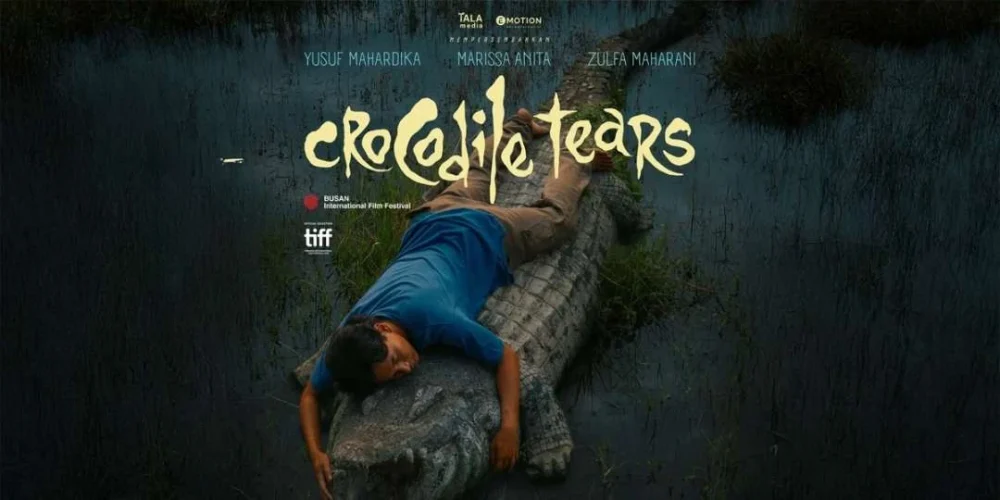

After making waves across international film festivals, Crocodile Tears is finally set to meet Indonesian audiences. Scheduled for theatrical release on May 7, 2026, the film arrives with an impressive list of accolades that firmly establish its artistic credibility.
Directed by Tumpal Tampubolon, Crocodile Tears has already earned the Direction Award and Nongshim Award at the Jakarta Film Week 2025. Its screenplay also received top honors at the Asian Film Festival Barcelona and secured a nomination at the Gothenburg Film Festival—a testament to its powerful storytelling and distinctive cinematic vision.
Tampubolon takes a bold approach by blending magical realism with psychological horror, crafting a film that is as emotionally resonant as it is unsettling. Rather than relying solely on plot, the film invites viewers to explore the fragile and often complicated dynamics within a family.
The inspiration behind the story is surprisingly simple yet deeply symbolic. The director once watched a documentary showing a mother crocodile gently carrying her young inside her jaws—a moment that felt both protective and terrifying. That duality became the emotional foundation of Crocodile Tears, reflecting how love can nurture, but also suffocate.
At the center of the film is Johan, a young man who grows up in isolation within a remote crocodile farm, living under the watchful eye of his mother, played by Marissa Anita. His world is small, controlled, and seemingly safe—but also limiting. His mother’s love, while genuine, comes with an intensity that quietly restricts his freedom.
Everything begins to shift when Johan meets Arumi, a woman who introduces him to a world beyond the boundaries he has always known. Through her, Johan starts to question his reality and imagine a different life. But this awakening comes at a cost.
As Johan pulls away, the once-stable bond between mother and son begins to fracture. His mother’s behavior grows increasingly unsettling, revealing the darker side of her attachment. What was once care begins to feel like possession, and love turns into something far more dangerous.
The emotional tension escalates into a deeply personal conflict—one that pits loyalty against independence, and affection against control. The presence of a third person, Arumi, acts as a catalyst, exposing hidden wounds and unresolved emotions within the family.
More than just a narrative, Crocodile Tears is a reflection on the complexities of parental love. It challenges the idea that love is always healthy, showing how it can become overwhelming, even destructive, when boundaries are blurred.
With its intimate storytelling and haunting atmosphere, the film offers more than entertainment—it provides a mirror. Viewers may find themselves questioning their own relationships, recognizing familiar patterns in the characters’ struggles.
In the end, Crocodile Tears lingers not because of its horror elements, but because of its emotional truth. It reminds us that sometimes, the deepest scars are not caused by hatred—
but by love that holds on too tightly




Leave a Reply